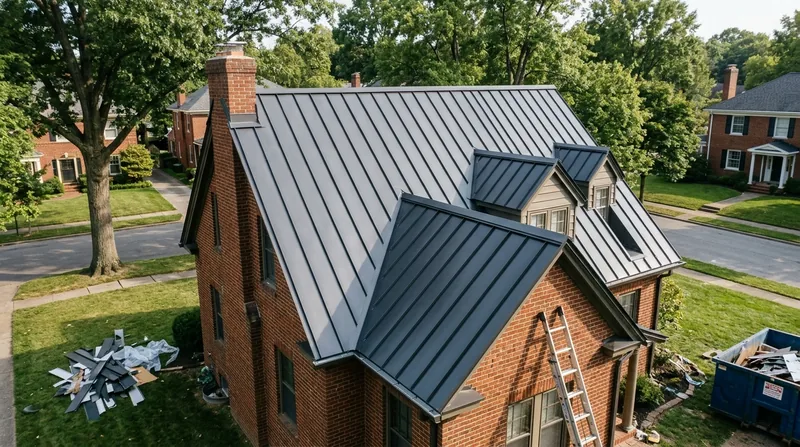




If you're considering Standing Seam Metal Roofing in Lexington, you already know the Bluegrass climate is hard on roofs. Humid summers, severe thunderstorms with hail and straight-line wind, ice storms, and freeze-thaw cycling work on every seam and fastener. On the 1830s to 1900s Federal and Victorian brick homes in Gratz Park and South Hill, and on the Craftsman bungalows in Chevy Chase and Ashland Park, a concealed-fastener standing seam roof is the system that holds up without exposed screws backing out. We roll-form panels to length on site, mechanically seam or snap-lock them, and leave a clean finish that sheds limbs from the bur oak, blue ash, and black walnut that shade these streets. If you want a roof that outlasts the shingles on the post-war ranches in Southland and Tates Creek, start with our metal roof installation page and then call us at (859) 785-4928.
Why Standing Seam Makes Sense on Lexington Roofs
Lexington sits on rolling karst limestone, and the freeze-thaw cycles that come with it are the enemy of exposed fasteners. A screw-down panel loosens as water works into the hole, and once that happens on a steep roof in Andover or Palomar, you're chasing leaks. Standing seam hides the fasteners under the panel and uses a raised seam that sheds water and ice. That matters on the steep composition roofs common in Hamburg and Beaumont, and it matters even more on the farm buildings out past the urban service boundary where metal is already the standard.
- Concealed fasteners eliminate the screw back-out that freeze-thaw cycling causes on exposed-fastener panels.
- Wind uplift resistance handles the straight-line gusts that come with Bluegrass thunderstorms and tornado warnings.
- Hail impact dents shingles and exposed panels; a heavier standing seam gauge resists it better.
- Long service life means fewer replacements on historic brick homes where tear-off is expensive and disruptive.
- Clean profile suits the Greek Revival and Italianate lines in Gratz Park and the Bell Court blocks.
For homeowners in historic districts and HOA-governed subdivisions, the panel profile and color are the first things to settle before anyone orders metal.
Key info: On a 1920s Tudor in Chevy Chase, we matched a standing seam profile to the original roof pitch and had the color approved by the HOA before roll-forming. That step saved the homeowner a rejected order and a two-week delay.
Before you commit, check the permit and inspection requirements with the Lexington-Fayette Urban County Government's building department at lexingtonky.gov, since thresholds vary by jurisdiction and project scope.
How We Install Standing Seam on a Lexington Home
We start with a roof inspection and measurements, then confirm panel profile, gauge, and color against any historic district or HOA rules. Panels are roll-formed to length so there are fewer end laps and fewer places for water to sit. We install the underlayment and eave trim, set the panels, and mechanically seam or snap-lock every rib. Finally we check flashing at chimneys and skylights, and we walk the roof with you before we pack up.
- We inspect the existing roof deck and note any soft spots, rot, or failed flashing.
- We measure and confirm panel layout, gauge, and color with you in writing.
- We roll-form panels to length on site to match the roof runs exactly.
- We install underlayment, eave trim, and the first panel, then work across the roof.
- We mechanically seam or snap-lock each rib and fasten the concealed clips.
- We detail chimney, skylight, and valley flashing before the final walk-through.
If your existing roof is sound and you want to avoid a full tear-off, ask about our metal roof over shingles option, which is limited by code to a set number of existing layers.
Key info: On a farm house outside Versailles, we roll-formed 26-gauge panels to 34 feet so the main roof run had no end lap. The owner had been patching a screw-down roof for years; the standing seam eliminated the leak points at the fasteners.
Standing Seam Approaches We Use in Lexington
Not every Lexington roof calls for the same panel. The right approach depends on pitch, budget, historic review, and whether the building is a residence or a farm structure. Here is how the main options compare.
| Approach | Description | Best for |
|---|---|---|
| Mechanically seamed | Panels with raised seams folded tight by machine for a watertight, high-wind connection. | Steep roofs and open, wind-exposed sites in Andover and the horse farms. |
| Snap-lock | Panels that snap together at the seam without a mechanical seamer. | Lower-slope residential roofs where a seamer cannot access the seam. |
| 26-gauge steel | Heavier-gauge panels with better hail and foot-traffic resistance. | Homes under mature bur oak and black walnut where limbs drop. |
| 24-gauge steel | Standard residential weight with a good balance of cost and durability. | Most Lexington subdivision homes in Palomar and Beaumont. |
| Kynar 500 finish | Factory-applied paint system that holds color under UV and hail. | Historic-district homes where color match is reviewed. |
We match the panel to the roof, not the other way around, and we tell you when a simpler profile will do the job.
Standing Seam Metal Roofing Cost in Lexington: What to Expect
Standing seam is the premium metal option, so expect a higher number than an exposed-fastener panel or a shingle re-roof. Pricing starts around $10 per square foot and moves up from there based on panel gauge, roof complexity, pitch, and access. A simple gable on a ranch in Southland prices differently from a cut-up Victorian roof in Gratz Park with multiple valleys and dormers. Tear-off of existing layers, deck repair, and flashing work add to the total.
- Panel gauge and finish (26-gauge and Kynar 500 cost more than standard 24-gauge).
- Roof complexity, including valleys, dormers, and chimneys that need flashing.
- Access and staging, especially on steep lots or tight historic-district streets.
- Tear-off and deck repair if the existing roof has soft spots or multiple layers.
- Historic district or HOA review that requires a specific profile or color.
Get two or three written estimates so you can compare gauge, finish, and what is included in the flashing and tear-off scope. Our full pricing overview breaks down the ranges in more detail.
Standing Seam Metal Roofing Near Me: Hiring a Contractor Near Lexington
When you search for standing seam metal roofing near me, the first thing to confirm is that the contractor is licensed and insured in Kentucky. Ask for a certificate of insurance and verify it covers both liability and workers' compensation. Get at least two or three written estimates, and make sure each one lists panel gauge, finish, underlayment, and flashing scope so you are comparing the same job. Ask for references from Lexington addresses, especially historic-district or HOA projects, and confirm who pulls the permit.
Historic district and HOA design review can restrict panel profile and color, so settle that before you sign. If your home is in Gratz Park, South Hill, or the Bell Court blocks, ask the contractor how they handle design review. A contractor who has done it before will know what the review board looks for. Reach out through our contact page to schedule a free estimate.
Key info: A homeowner in the 40507 ZIP code got three estimates and found the cheapest one excluded chimney flashing and used a lighter gauge. The written scope, not the bottom line, is what told the real story.
Call (859) 785-4928 to set up a free, no-obligation estimate.
Standing Seam Metal Roofing in Lexington: Pricing Guide
| Service | Price | Details |
|---|---|---|
| Standing seam installation (simple gable) | Starting at $10/sq ft | Includes panels, concealed clips, underlayment, and basic eave trim; pitch and access move the price. |
| Standing seam installation (complex roof) | Starting at $14/sq ft | Covers valleys, dormers, and multiple penetrations; roof cut-up and flashing scope drive the increase. |
| Tear-off and deck repair | On estimate | Needs an on-site look to count existing layers, check deck condition, and scope rot repair. |
| Historic district or HOA project | On estimate | Profile and color review plus custom trim require a site visit before pricing is final. |
| Travel | Included | In Lexington and surrounding areas, no separate call-out or mileage fee. |
| Estimate | Free | Response within 24h at (859) 785-4928, no obligation to book. |
Indicative pricing, the exact cost depends on square footage, finish, and site access. Free personalized estimate within 24h at (859) 785-4928.


